Book Review: Relentless in Pursuit

A few weeks ago I finished “Relentless In Pursuit: A Year in the Trenches with Teach for America” by Donna Foote. I began reading this book to research more about Teach for America since I had applied to the program. This book is the record Foote kept of the experiences faced by several TFA corps members during their first year teaching in 2006 at Locke High School in Watts, CA. At this time Locke was one of the lowest ranking schools in California and has some of the highest drop-out rates. Since that time Locke has become a Green Dot charter school so I am not sure how it is preforming currently, but in 2006 it was pretty rough.

I think this book is a great read for anyone that is interested in joining the TFA program. It gives a thorough explanation of how TFA started back in 1990 and how it has evolved through the years. It also shares the trials and tribulations of four TFA corps members trying to get through their first year of teaching in a school where most students didn’t show up and gang violence was an everyday occurrence. Funny enough, I actually finished the book on the day I discovered I was rejected from the TFA program.

Before I even applied to TFA I knew I had several issues with the program, and this book just emphasized those issues. Firstly, the book explains how many of the teachers at Locke High School in 2006 were actually permanent substitutes that were not certified to teach. As a certified teacher that cannot find a job, you can imagine this sends chills down my spine. Secondly, a lot of the difficult issues these first year teachers experienced bothered me. I believe all first year teachers are going to experience issues, so that was not the problem. What disturbed me was I had also dealt with most of their issues during student teaching. These were not new problems. Things like poor class attendance, student disrespect and distant, unreliable parents are universal issues in highly populated urban schools right now, they are not unique to schools like Locke. As these corps members struggled to figure out how to create lessons and deal with the difficulties of first year teaching, they all made mistakes along the way. Once again, this is to be expected for any first year teacher, and I think these corps members did a great job, but it just reemphasized the fact that these kids were no different than me. I had faced these issues student teaching, and I would face these issues again in my first year teaching.

So I suppose my main issue with TFA is this: although the program is one of the most competitive in the country, accepting roughly 2,000 corps members out of over 35,000 applicants, corps members themselves; extremely ambitious, ivy league graduates with a resume filled with leadership positions, look just like me when they start teaching. But unlike me, they will leave TFA in two years, complete with a Master’s degree and a resume of gold.

In addition, the inner city schools that these corps members are teaching in do not just need corps members, they need certified teachers. But the problem is there is no incentive for certified teachers to teach in the Mississippi Delta or Miami. My mother has 10 years of teaching under her belt, a Masters Degree in English and has taught in inner-city Las Vegas schools for the past two years. When she comes back to New York this summer I promise you nobody is going to thank her for the selfless work that she has accomplished there. She will just be another certified English teaching struggling to find a job closer to home in this tough economy.

I think we need to have another type of program that is similar to TFA, but only accepts certified teachers. They will continue to have the support system of TFA corps members, and they will also teach in urban schools and focus on closing the achievement gap. It will work towards getting dedicated, certified teachers in all schools across the country. And most importantly, these teachers will be praised and respected the same was TFA corps members are after their 2 years of service.

I apologize for this rant-type post. Back to my original point: if you have any interest in what TFA is all about I would highly recommend this book. I found in interesting and highly informative.
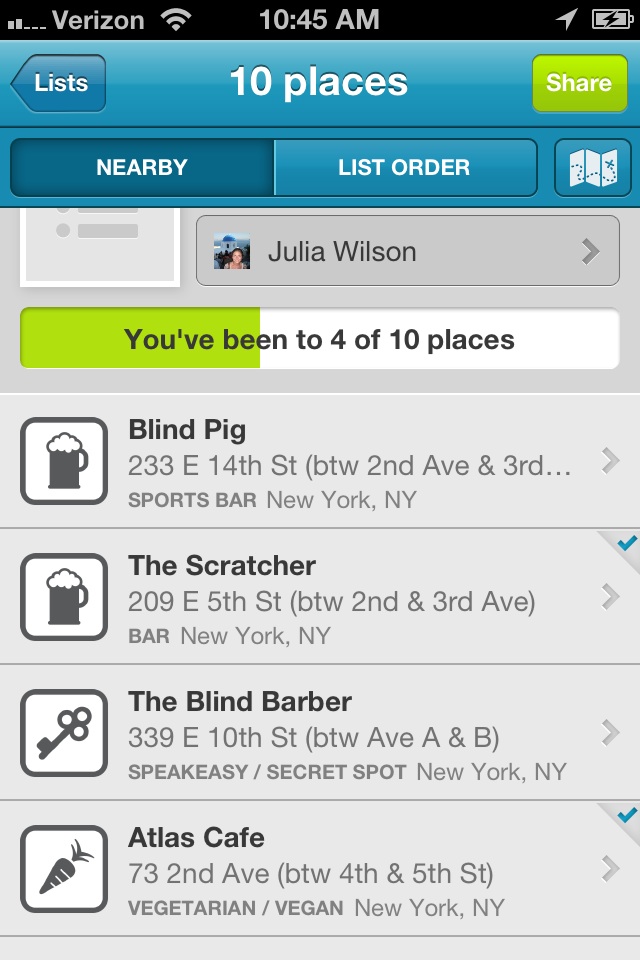
The power of foursquare lists!

In the two months I interned at foursquare several changes came out to the platform. One of the most exciting was the introduction of lists to both the website and eventually the iPhone and Android app. In the past three days Radar has come out of iPhone and now that is the most new and exciting addition to the platform. Radar is really cool, and I’m looking forward to seeing how it performs tonight when I go to the city for my friend’s birthday.

But today I want to tell you about a really positive experience I had 3 weeks ago using foursquare lists. I was going out on a Friday night with my boyfriend and my two housemates from college. None of us are native NYers but we all were commuting daily for school/work/internships. That day it was my responsibility to pick where we should hang out that night. I know NOTHING about cool places in the city and had no idea what to do.  But then I remembered, hey, I am friends with a bunch of foursquare employees that live in NYC and have obviously left plenty of tips at good venues to check out! I decided I would snoop around my friends tips at venues and create my own list of good places to check out that night with my friends.

Creating a list is pretty simple, I used my computer to create the list but I was easily able to add venues using my iPhone as well. I looked around for positive tips my foursquare friends had left at various venues around the city. If the bar seemed like a good time and was in walking distance, I added it to the list. So this was awesome, I now had a list of places I could check out with my friends that night.

Now I had an idea of where I wanted to go in the city, my only problem; I have the worst sense of direction on earth. And even though these places have nicely labled addresses I knew I would still struggle to find them. This is where my very favorite thing about lists comes in!

It conveniently places all the venues on a map for you! You can also click on the different pinpoints to see which venue is which. With this map and list of venues even I, the queen of getting lost, was able to direct my friends to different fun places around the city.

I was so proud of myself, I have always been the person that just follows people around while in the city, but finally I was able to lead my friends to cool and new places. This was so useful to me that day and I definitely plan on using lists again in the future. I could use lists again when i go to a new city, or create a list of local restaurants I’ve been meaning to check out. The possibilities truly are endless. And now with the introduction of radar, you even get a push notification when you are near a venue you have added to a list.

Why overthink? Confidence is key.

My brother is 9.5 years younger than me. Currently, he is a 12 year old boy that loves hanging out with other 12 year-olds, avoiding homework, playing x-box, and cheering on the NY Giants/ Detroit Lions.

The Monday night game this week is the first in Detroit since 1974. The Lions just scored a touchdown a few minutes ago and my brother came to knock on my door to see if I saw the play. I told him I had and that I was pumped. He then immediately closed my door and proceeded to knock on my Dad’s door.

My Dad wakes up at 6am every morning and is asleep by 10:15 every night. When I was 12 years old I would have never knocked on my Dad’s door at 10:50pm. There have been nights, even this year, that I wonder if my dad is still awake when I see the TV glowing from underneath his door. But I still don’t want to knock, I don’t want to disturb.

Every year my Mom bakes Christmas cookies that we deliver to the neighbors. When I was younger I dreaded delivering those cookies. The neighbors were always happy to see me, (who is bothered by a cookie delivery?) but it was just so awkward. Now my brother happily looks forward to delivering the cookies on Christmas Eve.

He also has one of those lame school fundraisers where you sale baked goods and tchochkes from a catalog in hopes of gaining a $5 prize. He has gone door to door to all of our neighbor acquaintances, and he has already sold over $50 worth of goodies. He is not ashamed or embarrassed at all, he wants to gain fund-raising money so he is perfectly fine with asking neighbors for help.

I always over thought everything. I would feel so awkward it would almost consume me! If I knocked on my sleeping father’s door at night, really what bad things could happen? My brother does not have this fear. He knows what he wants and if he might feel awkward or embarrassed on his path to achieving his goal it doesn’t matter because he wants to get things done. It took me years to gain the skills he has now. I am proud of him and I think this confidence will get him where he wants to go when he’s older.

Ideas for Teaching

Hello, long time no chat. This week is my last week at foursquare. I know I will have a lot of free time next week so I keep procrastinating about a new blog post. I keep thinking, “Oh, I’ll have so much time to do that next week.” This is true, but I thought I would post something today.

I would also like to mention that today I was rejected from Teach for America. I didn’t even get to the interview stage. I felt pretty poor about myself for a few minutes, but you know what? I have my whole life to become a good teacher.

Here are some of the things I plan to do when I become a teacher.

1. Have Clear Academic Expectations for Students.

  • Create an website for myself (possibly through the school if they offer it) to post class assignments, class expectations, assessment dates and my contact information. This could be a resource for students with computers at home. It could also be a way for parents to monitor their students assignments.
  • Always post the days objectives and homework/assignments on the board.
  • A portion of the “Do Now” time at the beginning of class will be reserved for copying down assignments.
  • Rubrics, Rubrics, Rubrics! I would create them when necessary, mostly for essays and projects.  We would always take some class time to go over the rubric material. I would remind the students to check over the rubric after completing their assignment to make sure they had completed all the requirements.
  • Provide a review day before every test
  • This goes along with the rubric, but I would always devote some class time to fully explain a project or essay. I would also take time to periodically remind the kids to continue working on the assignment on the days leading to its due date.

2. Have Clear Behavioral Expectations.

  • Create a class contract. This is an idea I would like to play with if I ever teach. On the first day of school the students would be required to think of important rules we should make that everyone would abide by for the whole year, and we would put this in a class contract. We would talk them over together and I would show my main rules that I thought needed to be in the contract. (Respect others, come to class prepared, complete homework, etc) The next day I would come in with the finished product. The students would be responsible for signing the contract and agreeing to the terms and conditions. I would post a large copy of the contract at the front of the room. Students who disobeyed our contract would be dealt with accordingly.
  • Similar to what I was just saying, class rules should be posted somewhere in the class.
  • There should be a punishment policy. Something like “Minor offense/1st offense= warning. Offensive behavior/2nd offense= lunch detention. Major offense/3rd offense= referral and ejection from the classroom.” I hate taking kids out of class, but sometimes when they are a distraction to others, it needs to be done. Also, a lot of kids also stop misbehaving when the threat of being kicked out happens. (some kids are unfazed though, unfortunately.)
  • Sometimes other punishments can happen. For example, if groups are trying to gain points during a review game, i could deduct points for bad behavior.
  • NEVER ARGUE with a student. The second you argue, the second that you have validated the claim that they actually have a point to argue against.
  • Along the same lines, keep your cool. Kids are entertained seeing a frazzled, angry teacher and you also lose respect.
  • When things get too chatty or crazy, switch assigned seats.
  • Have plans that should cover the entire period to eliminate down time.
  • Call/email parents. It matters!

3. Have a Routine.

  •  Have a “Do Now” every day when the students walk in. For me, this typically included copying down homework assignments and some sort of short answer question about the previous days material.
  • Post Aim/Objectives on the board everyday. (This is required by many schools.)
  • Unit Vocab Sheet: I created a vocabulary sheet that the students brought to class everyday. We would fill out the definitions in class. This sheet became a great study guide for the students, and a really easy A when the students handed it in for a grade on the day of their test each unit.
  • Always provide unit review sheets/Unit Review day. I’m a big fan of creating a review sheet and playing a review game the day before a test. This way the students realize if they are unprepared and it ensures that they did at least a little bit of studying/review before a test.

4. Differentiate.

  • I LOVE routine, but that doesn’t mean you class needs to be boring!
  • Make sure lessons and assessments are both differentiated often.
  • Differentiated Assessments include: Tests, Quizes, Homework, Essays, Art Projects, Computer Projects, Group Projects, Presentations, etc.
  • Relate any content material you can to current events! Sometimes new events pop-up that coincide well with the content material. For example, a lot of people have been referring to Occupy Wallstreet as an act of civil disobedience. If you are teaching Indian Nationalism or the Civil Rights movement… incorporate this new stuff!
  • Try to work with another teacher to pair units together. For Social Studies you could work with an English teacher to teach a history Unit that coincides with the literature they are reading in English class. I also think you could do Geography based things with a Science teacher.
  • I love class field trips, but make sure the trip can relate to what you have been studying. If the students can take a trip and see the knowledge they gained in the classroom is relevant in other places they will be more engaged in the the trip. Also, make sure they go somewhere interesting! (I went to way too many Revolutionary War battle sites as a kid.)

5. Work Hard.

  • Have lessons fully planned at least a week in advance. Make sure you have all the materials and copies you will need as well.
  • Make sure your unit plan has clear objectives and a basic time line of events/topics before you start.
  • Keep your room and desk clean and organized.
  • Only assign work that is meaningful, don’t give kids busy work for homework.
  • Return work in a timely fashion. This will show the students that you take their work seriously.

6. Be Involved.

  • Go to the students extra-curricular events. (Talent shows, concerts, games, plays, meets.) You should know what achievements your students are making in and out of the classroom.
  • Chaperon trips, advise clubs, coach teams if time allows.
  • Praise students for positive achievements. Call parents when a student has made great improvement!